Original: $65.40
-70%$65.40
$19.62The Story
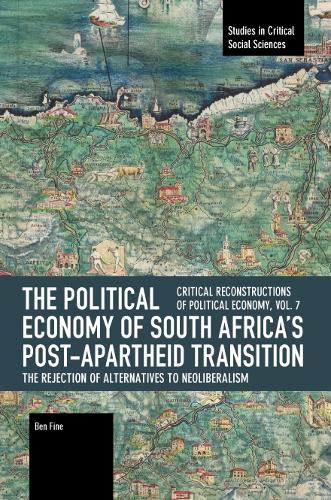
This peer-reviewed book series offers insights into our current reality by exploring the content and consequences of power relationships under capitalism, and by considering the spaces of opposition and resistance to these changes that have been defining our new age. South Africa’s post-apartheid transition has proven disastrous. But what caused this unfortunate trajectory? Today, the country is marked by the emergence of a black elite of enriched capitalists who have benefitted from the globalization, neoliberalization and financialization of the economy in general, and from its Minerals-Energy and Financial Complex in particular. By contrast, inequalities, poverty and failing social provision have persisted. Recent attention has shifted to how this trajectory was initiated, with some suggesting a lack of available alternative policy options at the time of transition. The Political Economy of South Africa’s Post-apartheid Transition shows this to be false. In fact, a full range of progressive alternatives were rejected, leading to corresponding consequences from “state capture” to electoral defeat.
Description
This peer-reviewed book series offers insights into our current reality by exploring the content and consequences of power relationships under capitalism, and by considering the spaces of opposition and resistance to these changes that have been defining our new age. South Africa’s post-apartheid transition has proven disastrous. But what caused this unfortunate trajectory? Today, the country is marked by the emergence of a black elite of enriched capitalists who have benefitted from the globalization, neoliberalization and financialization of the economy in general, and from its Minerals-Energy and Financial Complex in particular. By contrast, inequalities, poverty and failing social provision have persisted. Recent attention has shifted to how this trajectory was initiated, with some suggesting a lack of available alternative policy options at the time of transition. The Political Economy of South Africa’s Post-apartheid Transition shows this to be false. In fact, a full range of progressive alternatives were rejected, leading to corresponding consequences from “state capture” to electoral defeat.